
Presidio County Sex Offender Checks
The Texas Public Sex Offender Registry, maintained by the Texas Department of Public Safety, is the main public search channel for Presidio County. It is free and covers reportable Texas registrations submitted by local authorities. Start there for a countywide view. Search by a full name when the person is known, or use the county, city, address, ZIP, radius, and map paths when the concern is tied to a place.
A result deserves a close identity check. Compare aliases, age or date of birth, physical details, photo, address, offense facts, and the registration authority. Rural Presidio County locations may be described rather than mapped with street-level precision, so an empty map area does not settle the question. The profile's update or verification details help show how current the record is. Contact the listed local authority or DPS if a field conflicts with other official information.
Texas Public Sex Offender Registry Searches
The state portal supports several paths because one search style will not fit every need. A name search works best with a full legal name and known aliases. County mode gives a broader Presidio County set. Address and map modes are better for a street or nearby area, but rural location descriptions may not geocode in the same way as an in-town address. Follow the current interface labels because its controls and offered radius choices can change.
- Open the DPS public registry and read its conditions of use before entering a search.
- Choose name, address, city, county, ZIP, radius, or map search. Select Presidio for the county path.
- Review the result list and compare several identifiers instead of relying on a similar name alone.
- Open the full profile, note the registration authority and update details, then use that authority for a discrepancy or suspected violation.
| Field label | Type | Required | Use |
|---|---|---|---|
| Last Name | Text | Name path | Combine with a first name or known alias |
| First Name | Text | Route dependent | Narrows a surname search |
| Address | Text | Address path | Enter street, city, and ZIP as prompted |
| City | Selector or text | City path | Choose a Texas municipality |
| County | Dropdown | County path | Select Presidio |
| ZIP Code | Text | Optional or path based | Use a five-digit ZIP |
| Radius | Dropdown | Address path | Use a distance offered by the live portal |
| Map Search | Map control | Optional path | Pan and zoom to the area of interest |
The DPS registry search screen shows the official statewide interface used for these paths.
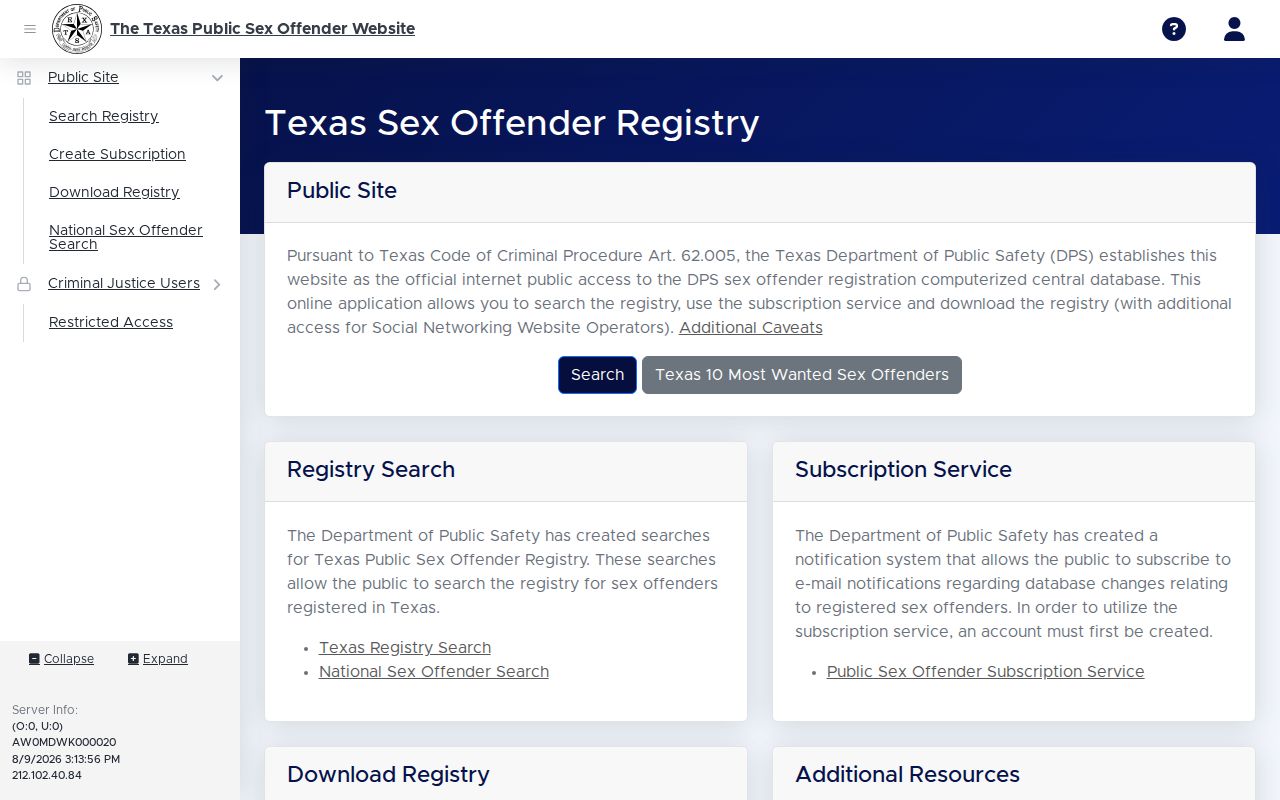
That interface is the repeatable starting point, while local police and the sheriff remain the contacts for address or compliance questions.
Presidio County Registry Map Limits
Presidio County covers a vast border landscape with two incorporated cities and wide areas outside municipal limits. A pin-based registry view is useful around a known address, school route, park, or gathering place, but it can be less exact where roads, ranch entrances, or residence descriptions do not map cleanly. Search a wider area when the location is near a city edge or county line. Repeat the search with a name or county filter rather than treating one map result as complete.
Location data can also change after a move is reported and processed. Note the displayed update information and check again when a decision depends on current geography. A registered address is not an invitation to visit, enter land, watch a residence, or contact anyone there. Use the data for family and community awareness. For immediate danger call 911; route a suspected reporting violation to the authority responsible for that address.
Registry Profiles: What They Show
A public DPS profile joins identity, appearance, residence, registration, and offense information. Texas local authorities collect even more information than the public sees. The public record excludes Social Security and driver's-license numbers, phone numbers, online identifiers, employer-identifying information, victim-identifying details, confidential fields designated by DPS, and juvenile material ordered nonpublic. Those limits protect data that Chapter 62 does not make part of the public display.
| Name and Aliases | Reported legal name and other names tied to the registration record |
|---|---|
| Photo and Description | Photograph, sex, race, age or birth date, height, weight, hair, eyes, and identifying marks when public |
| Address or Location | Registered address or a detailed place description, subject to the public fields allowed by law |
| Offense Information | Description, statute, conviction or adjudication date, jurisdiction, sentence, and public victim age or sex category |
| Risk and Authority | Assigned risk information where applicable and the police or sheriff authority responsible for registration |
| Status Details | Registration status, supervision or institution facts, and update or verification information shown by DPS |
| Other Public Fields | School, vehicle, scars, marks, or tattoos when collected and released under Chapter 62 |
The DPS registration program overview explains the state and local roles behind the public data.
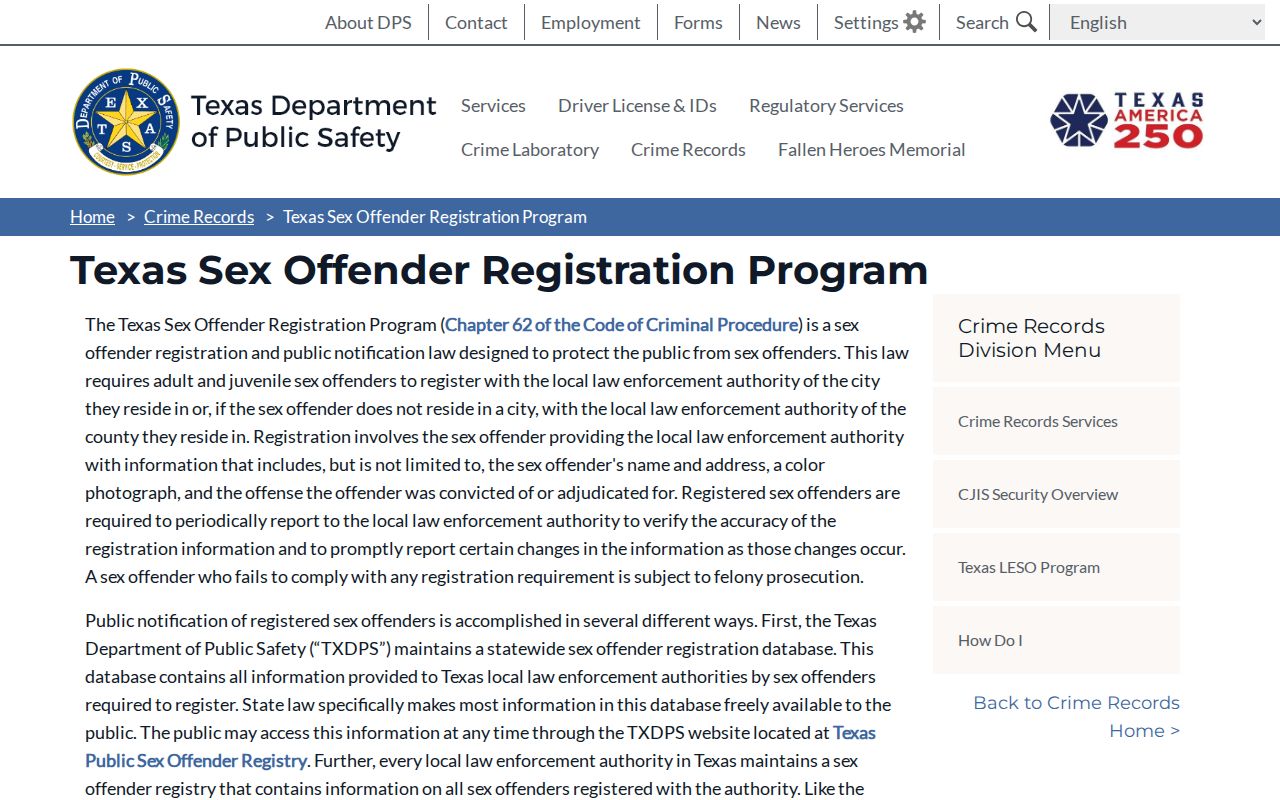
The program material helps distinguish information used to administer registration from the smaller set released in a public profile.
Presidio County Cross-Border Searches
The National Sex Offender Public Website adds a cross-jurisdiction layer when a person may have lived, worked, or studied outside Texas. That can matter in a county on an international boundary and for moves through nearby counties or other states. NSOPW searches participating public registries. It does not replace DPS for the details of a Texas registration or the local authority for a current Presidio County address question.
Begin with the Texas portal when the known location is in Presidio County. Then repeat a name search in NSOPW when the search crosses a state line or a recent move is possible. Try aliases and review the source registry behind a national result. Out-of-state, federal, military, or foreign offenses can require a substantial-similarity decision by DPS, so readers should not decide Texas registration duties from an offense title alone.
The official NSOPW search presents the national terms and participating-jurisdiction route.
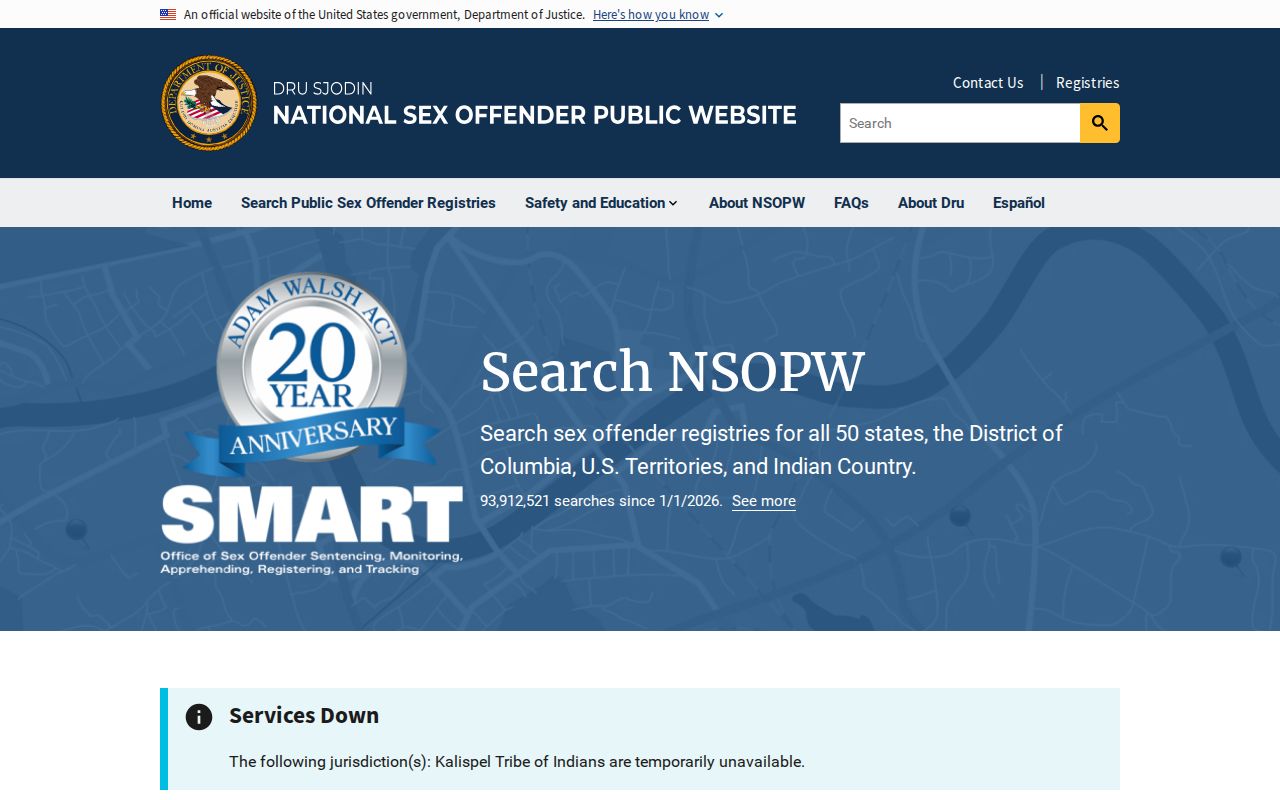
A national result should lead back to the originating public registry for its current profile and jurisdiction-specific meaning.
Registration Levels and Duties in Texas
Texas does not use a simple public Tier I, Tier II, and Tier III duration chart. The specific reportable conviction or adjudication controls the duty under Code of Criminal Procedure Chapter 62. Adult duties are generally lifetime or ten years after discharge from incarceration, parole, or community supervision. Juvenile duties generally last ten years after the later statutory release, discharge, or dismissal point, while a court may alter publication or registration in qualifying cases.
| Texas category | General duration | Public visibility |
|---|---|---|
| Adult offense on the ten-year list | Ten years after discharge from incarceration, parole, or community supervision | Most Chapter 62 public data is displayed |
| Adult sexually violent or other lifetime-listed offense | Life | Risk findings may add community notice |
| Juvenile reportable adjudication | Generally ten years after the later triggering discharge or dismissal | A court may restrict public data in qualifying cases |
| Extrajurisdictional registration | Depends on Chapter 62, substantial similarity, and the originating duty | Confirm the Texas result with DPS |
Verification frequency can vary with designation and circumstances. Registrants must report specified changes promptly rather than wait for a regular check-in. Initial local registration is due no later than the later of seven days after arrival or the first date allowed by the authority's policy. Use the statute and DPS guidance instead of a hand-built eligibility or duration calculation.
The official Chapter 62 text shows the offense-based structure behind registration duties.
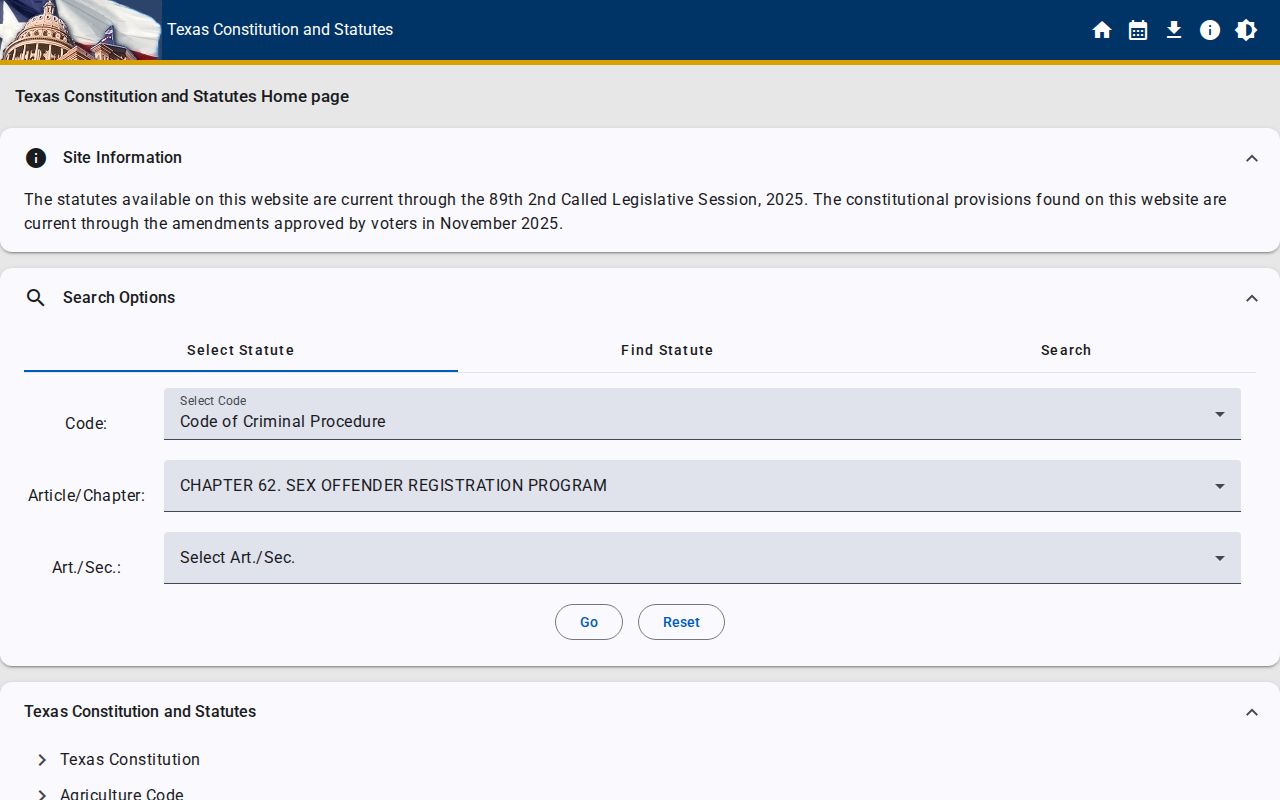
The law's detailed categories explain why a profile cannot be reduced to a federal-style tier label or a guessed end date.
Presidio County Registry Notification
Community notice is broader than a portal result, but it does not guarantee that each resident receives personal mail. Local authorities maintain their registries and notify schools as Chapter 62 requires. DPS may mail English-and-Spanish postcards when a civilly committed sexually violent predator or high-risk registrant is due for release or moves into a community. A local authority may also use a publication method allowed by law.
These channels serve different aims. The public portal lets a resident repeat a search at any time. School and postcard notices apply only when legal conditions are met. If a family wants ongoing awareness around a place, use any subscription or notification option shown by the live DPS interface and keep the search area current. Do not infer that silence means no registered person is nearby. Data may be processing, and rural descriptions may affect map display.
Report Presidio County Registry Gaps
A missing update, an address conflict, or a suspected failure to register belongs with law enforcement, not in a personal confrontation. Use the City of Marfa police authority for an address in Marfa, City of Presidio police for an address in Presidio, and the Presidio County Sheriff's Office for an unincorporated address. DPS's Sex Offender Registration unit can be reached at (512) 424-2800 for state-program questions.
Give the authority the profile name, displayed registration authority, address or location at issue, and the facts that caused concern. Avoid conclusions about guilt or danger. An old address may reflect a report being processed, a mapping issue, or a violation that only the responsible authority can assess. Call 911 for an immediate threat. For a nonurgent data issue, preserve the profile's update details and ask the agency to review the official record.
Using Registry Information Lawfully
Registry information supports personal, family, and community safety. It does not predict new conduct, and a listed profile does not establish guilt of any new offense. Use the official record to understand a registration status, plan ordinary safety steps, and pass a specific concern to the proper authority. Never enter listed property, organize public shaming, publish private household details, or urge others to watch or contact a registrant.
Lawful-use warning: Misusing registry information to harass, threaten, intimidate, or commit a crime against a registrant is unlawful under Texas Code of Criminal Procedure Chapter 62. Report suspected noncompliance to police or the sheriff and call 911 for immediate danger.
Verify information before acting on it. People move, update times vary, and similar names can point to different people. The profile describes a legal registration status and reported facts. It is not a license to discriminate, threaten, surveil, or interfere with a household.