
Marfa Criminal History Checks
Begin a Marfa criminal history check with the event, not with a broad request for a "criminal record." The office that created each document remains its custodian. Marfa Police holds its incident and arrest narratives. Marfa Municipal Court holds city citations, fine-only state cases, pleas, payment records, and its own warrant information. The Presidio County sheriff and jail hold county booking and custody records. The combined county and district clerk keeps filed county and felony cases. Texas DPS adds a statewide public layer, but that name search is limited to reported convictions and deferred adjudications.
- Identify whether Marfa Police, another state agency, or a federal agency handled the event.
- Use the City of Marfa public-information channel for a city police report, with the date, place, names, and incident number.
- Ask Marfa Municipal Court about a city citation or municipal warrant by name and citation number.
- Check the county jail for booking or current custody and the combined clerk for a filed county or district case.
- Use the Texas DPS conviction search only as the statewide reported-conviction and deferred-adjudication layer.
Three Marfa Record Counters
Three important Marfa records offices sit along Highland Avenue, but they are not one department. City Hall and Municipal Court are at 113 S. Highland Avenue. The Presidio County Courthouse is at 300 N. Highland Avenue, and the sheriff's office and current county jail are next door at 320 N. Highland Avenue. Their closeness can hide the legal split. A Marfa Police narrative does not become a sheriff report merely because the jail booked the person. A booking entry does not become the filed court case, either.
Match the request to the record stage. Ask the city for the police report, Municipal Court for a citation file, the jail for intake and release facts, and the combined clerk for pleadings or a final judgment. Telephone confirmation can prevent a wasted stop, especially when a record has moved to paper storage or belongs to a different court level.
Records at Marfa Police Department
The Marfa Police Department page is the official starting point for a report generated by a city officer. Ask for the public portion of the incident or arrest report and identify the event as tightly as possible. Helpful details include the date and time, location, involved names, incident number, record type, desired electronic or paper format, and a cost ceiling. A dispatch entry, body-camera recording, 911 audio, booking sheet, and court file are distinct products, so name each one sought.
No verified Marfa police report-search portal or law-enforcement mobile app was found. That makes the city's public-information process the practical written route. Active investigations, juvenile material, victim details, driver's-license data, and other protected content may be withheld or redacted. If an officer made an arrest, the police report still stays with Marfa even when the custody record goes to the county jail.
The city's official police page shows the local department and its public-facing information:

That source is the right lead for a Marfa incident record before moving to county booking or court channels.
Requesting Marfa Police Reports
A precise Marfa public-information request works better than asking for everything connected to a name. State the agency, event date and location, the known people, and the report or incident number. Ask for an electronic copy when possible and request an itemized estimate before charges pass a stated limit. The Texas Public Information Act calls for prompt production, but it does not promise that every request will be filled within ten business days. That familiar deadline usually concerns an agency's request for an attorney general ruling when it seeks to withhold information.
Do not send a city request to the sheriff just because a Marfa arrest ended at the county jail. The sheriff can answer for its booking and custody records, not the city officer's narrative. Likewise, the city cannot certify a felony judgment held by the county clerk. If Marfa says it has no responsive report, verify the agency name, spelling, date, and incident number before deciding that no record exists.
Booking and Arrest Records in Marfa
Marfa Police arrests are traced through two custodians. The city holds the officer's incident and arrest report. Presidio County Jail at 320 N. Highland Avenue holds the booking and custody facts after intake. The sheriff also publishes year-by-year arrest pages, including a current annual page and archives reaching back to 2014. Those pages are chronological publications. They are not a live jail roster, a full name-search database, or proof that prosecutors filed or won a case.
For current custody, telephone the sheriff or jail and provide a full legal name plus date of birth if requested. Ask for the booking number, intake time, arresting agency, charges presented at intake, bonds by charge, release status, and holds. Then ask the combined clerk whether a cause was filed. Booking language may differ from the complaint, indictment, plea, or judgment because each comes from a later stage.
Note: A Marfa arrest page documents an accusation and booking event, not guilt or the final case result.
Marfa Citation Appearance Rules
Marfa gives adults several ways to answer a citation by its appearance date: in person, by telephone, or by mail. Fax and email do not count as an appearance. A signature on the citation is a promise to appear, not a guilty plea. Mail must be postmarked on time. These details matter because a late or invalid response can lead to added cost and a warrant, even when someone thought an email had resolved the matter.
Juveniles under 17 follow a different Marfa process. A parent or guardian must participate, and the matter proceeds in open court after reset. Anyone uncertain about a deadline, plea option, or juvenile setting should use the court's current instructions and contact the clerk before the appearance date.
The Marfa Municipal Court File
Marfa Municipal Court hears city-ordinance cases and fine-only state-law offenses. Ordinary fines may reach $500. Fire-safety, zoning, public-health, and sanitation ordinance fines may reach $2,000. The court is at 113 S. Highland Avenue, Marfa, TX 79843, and its phone is (432) 729-4315. The official page identifies Judge Dina Jo Marquez, City Prosecutor Christopher Gad, and Clerk Cherry Torres; the clerk's email is courtclerk@cityofmarfa.com.
No public city case-name portal was verified. Call or visit with the name, citation number, date of birth if requested, offense, and appearance date. Ask for the current plea, setting, balance, warrant status, disposition, and copy options. A city file does not cover a felony filed in District Court.
| Court Name | Marfa Municipal Court |
|---|---|
| Case Types Heard | City ordinances and fine-only state-law offenses, including traffic matters |
| Case Lookup Channel | Telephone or clerk counter; no verified public name-search portal |
| What the File Shows | Citation, plea, settings, disposition, fine, costs, payment activity, and warrant status when applicable |
| Copies & Fees | Ask the clerk for current availability, copy charges, and certification options |
The official municipal court page displays its jurisdiction and local warrant information:
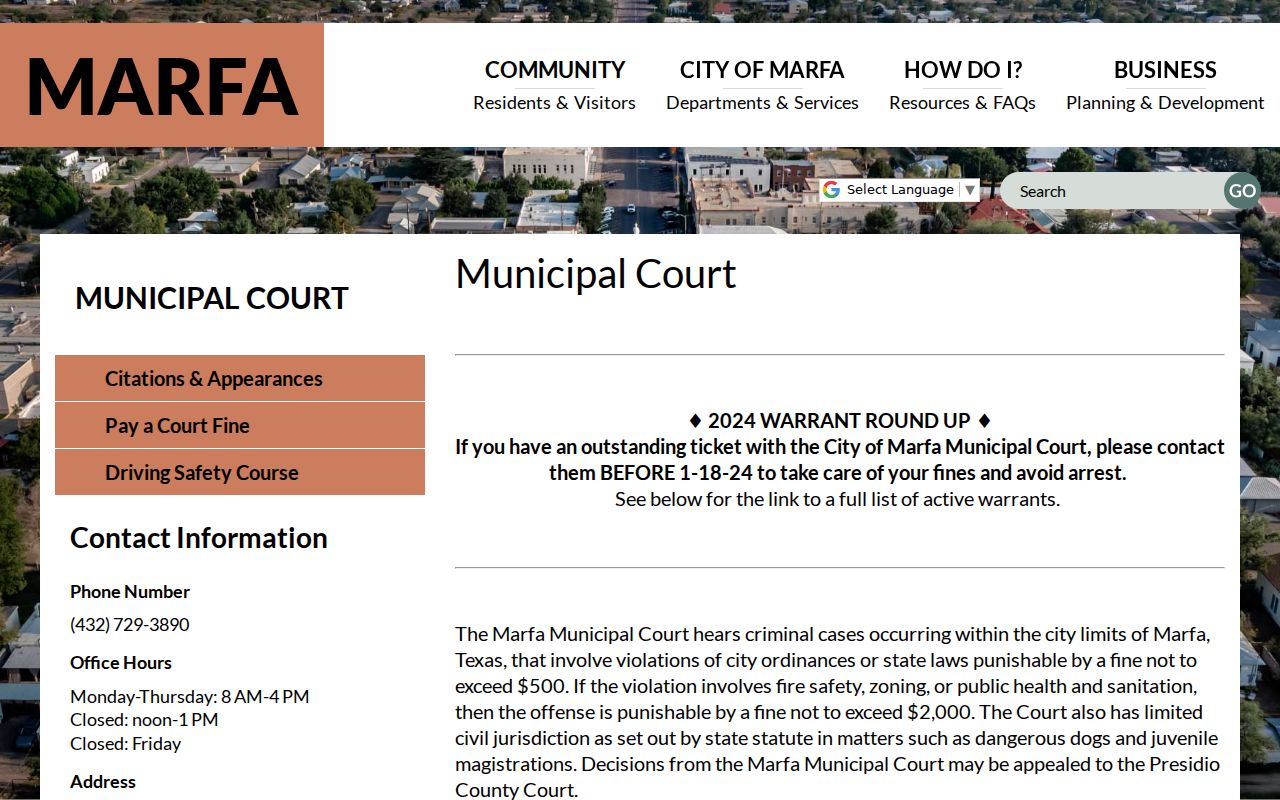
The court source helps distinguish a Marfa citation file from a county misdemeanor or district felony record.
Marfa Warrant Records Need Confirmation
Marfa's court page retains a 2024 warrant-roundup notice and an active-list link. It proves that municipal warrants have their own city channel, but a posted list can age. Payment, recall, a new order, or later court action may not yet appear in an older copy. Call the Municipal Court before relying on a name or attempting to resolve a warrant in person.
A municipal failure-to-appear warrant is not a district felony case. District capias records, county cases, and justice-court warrants belong with their issuing courts. Texas also has no general public statewide TCIC warrant portal. If the concern is urgent, use the court or law enforcement rather than waiting for a public-information response.
How Marfa Records Reach the County
A Marfa incident can create several records on different clocks. The police record begins when the event is reported or observed. The custody record begins at arrest and jail intake. A prosecution starts when a complaint, information, or indictment is filed. Texas criminal-history data changes after agencies transmit reportable fingerprint, charging, and disposition events. Hours, days, or months can separate those steps.
Record flow: Marfa Police Department › Presidio County Jail › Presidio County Courts › Texas Department of Public Safety
Check the city first for a fresh incident. Use the jail for booking or current custody, the combined clerk for the filed outcome, and DPS for the narrower statewide public product. A "no result" at DPS does not prove that Marfa Police made no arrest or that no local case exists. Broader county routing is explained in the Presidio County criminal history overview.
Marfa's 1886 Record Hub
The Presidio County Courthouse at 300 N. Highland Avenue remains a working records center as well as a landmark designed by Alfred Giles. The combined county and district clerk's public counter is on the first floor. It is the critical Marfa-area stop for a felony file, county case, older docket, certified judgment, or local expunction procedure. The office can be reached at (432) 729-3857.
The courthouse does not absorb every Marfa record merely because it is close to City Hall. Municipal citations remain at the city court. Police narratives remain with the city. Jail intake remains with the sheriff. Ask the clerk for a docket sheet first, identify the court level, and confirm whether an older file is stored off site before traveling.
Marfa Court Payment Records
The city publishes official court fine payment options, but payment information is only one part of a municipal file. A balance can include a fine, court costs, a payment plan, and added amounts tied to later enforcement. It is not the same as bond, which secures appearance, and an unpaid fine does not convert the original citation into a felony.
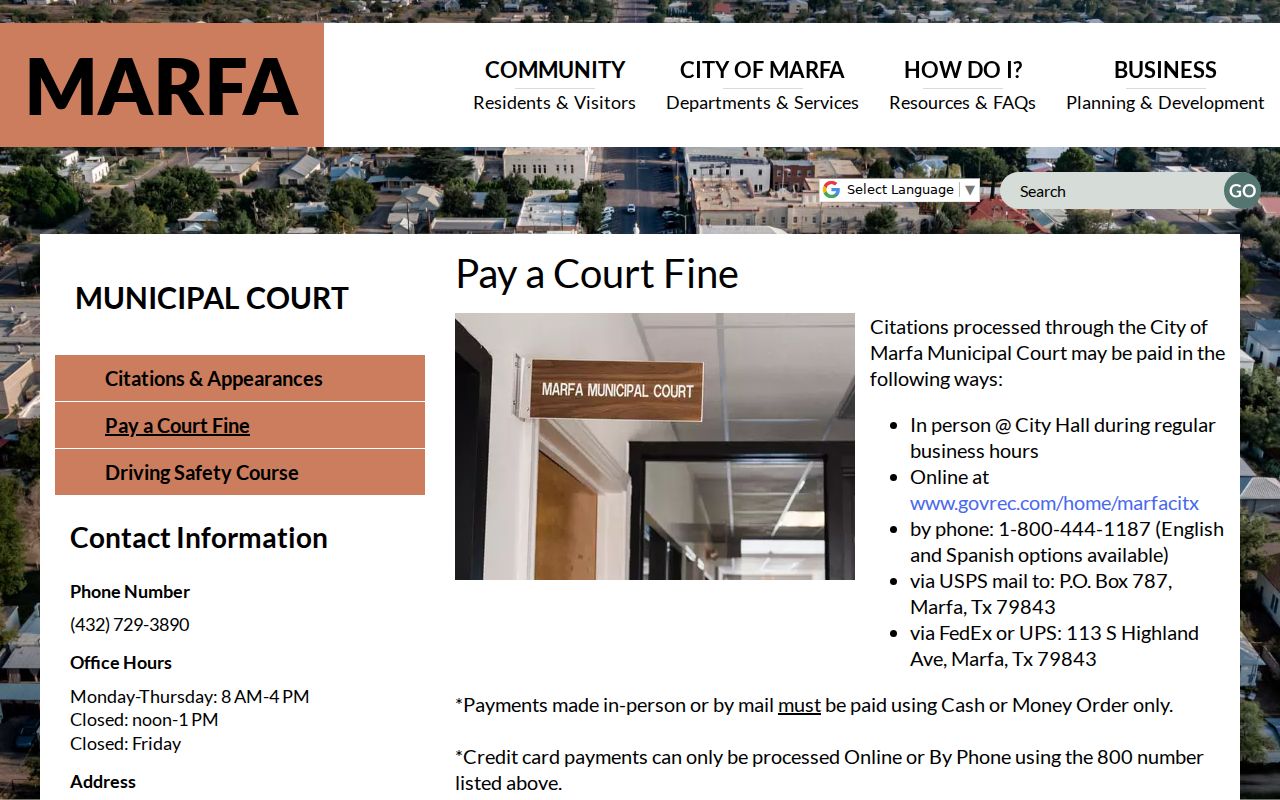
The payment page helps verify the city's accepted channels, while the clerk remains the source for the current balance and case status.
Appealing Marfa Municipal Records
An appeal from Marfa Municipal Court goes to Presidio County Court. That shift creates a county file distinct from the original city citation record. Ask the municipal clerk what was transmitted and use the county clerk to confirm the appeal docket. A setting is not an outcome, and an index status should not replace the signed judgment or appellate order.
If proof of the result is needed, request the final signed record from the office that issued it. A certified judgment, dismissal, acquittal order, or appellate mandate is stronger evidence than a payment screen or warrant list. The Presidio County Court Case Lookup explains the county and district file path in more depth.
Marfa Record Access Rules
The Texas Public Information Act generally applies to City of Marfa administrative and police records, but court files also operate under judicial authority and court rules. Government Code Section 552.021 establishes the broad right to inspect public information, while Section 552.221 requires prompt production or notice of when a record will be available. Law-enforcement material can be limited by active-case rules, privacy law, juvenile protections, victim safeguards, and body-camera requirements.
Ask Marfa for a redacted public copy rather than treating a withheld portion as a denial of the whole record. Court records should go to the court clerk, not to DPS under a generic TPIA request. DPS maintains its own criminal-history system and public conviction search; it does not hold the city's original police narrative or municipal case file.
Key Statutes:
Texas Government Code Chapter 552 gives access to public information while defining exceptions and request duties.
Texas Code of Criminal Procedure Chapter 66 governs how reportable criminal events move from local agencies into state history systems.
Texas Government Code Chapter 411 controls criminal-history dissemination and authorizes public access to reported convictions and deferred adjudications.