
Criminal Court Cases in Presidio County
The 394th Judicial District Court hears Presidio County felony cases. The district spans Presidio, Brewster, Culberson, Hudspeth, and Jeff Davis counties, but each county keeps its own files. A Presidio County felony therefore stays with the combined county and district clerk in Marfa even when a prosecutor works from an office in Alpine or Fort Stockton. An indictment, court settings, motions, plea papers, judgment, and sentence become parts of that local district file.
Presidio County Court handles its statutory criminal work and appeals from Marfa Municipal Court. Justice of the Peace Precincts 1 and 2 keep matters within their own jurisdiction. Marfa and Presidio municipal courts retain fine-only city and state cases. Court level is not a small detail. It decides which clerk can find the cause number and issue a certified copy. The Texas Judicial Branch provides court directories, rules, and statewide context.
The official Judicial Branch source shows how Presidio County court records fit within the Texas court system.

That statewide framework helps identify the court, while the Presidio County clerk remains the source for the actual local file.
Presidio County Court Record Levels
A citation, complaint, information, and indictment point to different routes. A complaint can support early action or charge a fine-only case. An information ordinarily charges a misdemeanor. A grand jury indictment accuses a person of a felony. None proves guilt. Start with the court name printed on the citation, bond paper, warrant, or docket notice. If the document names a municipal or justice court, contact that office rather than assuming the district clerk owns the record.
The county publishes a justice court directory for local routing. Precinct 1 and Precinct 2 maintain their own dockets, despite the combined clerk's broad county role.
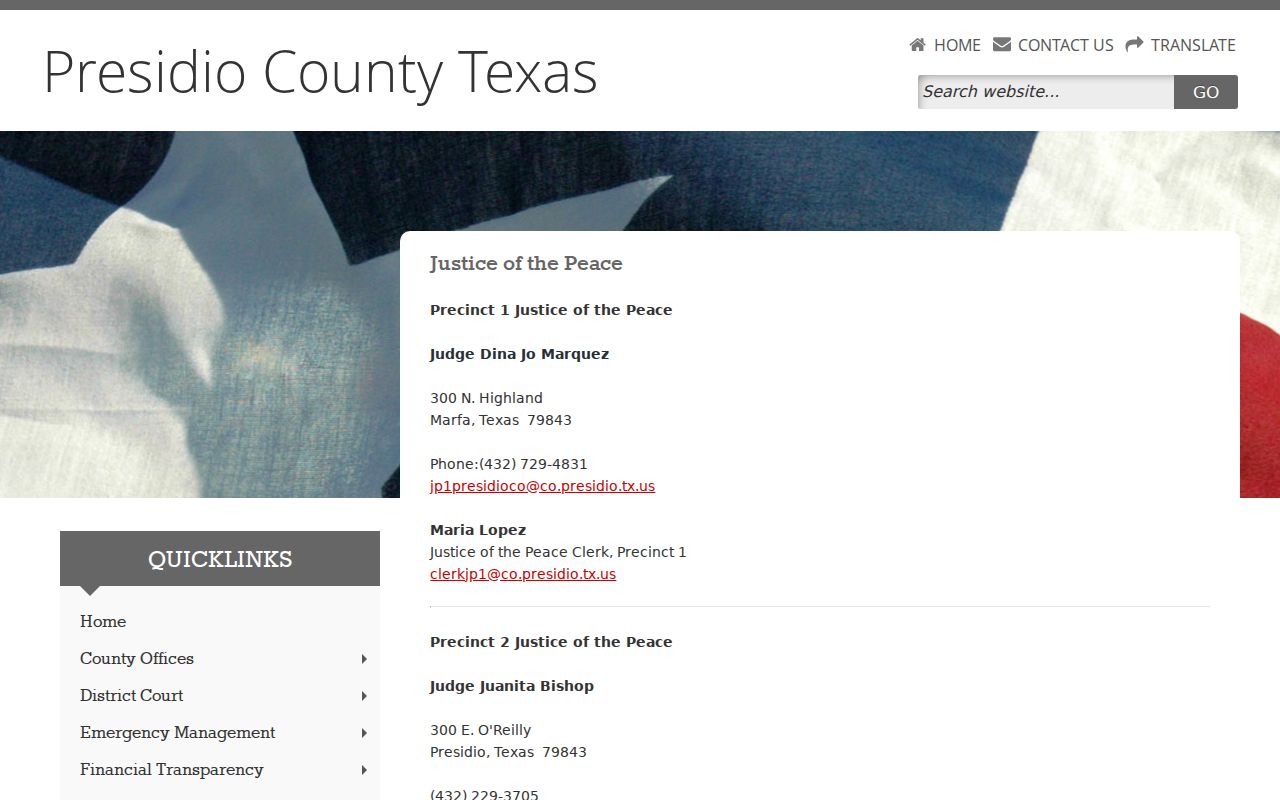
The directory is useful when a fine-only matter does not appear in a district or county case search.
The county also posts separate Precinct 1 Justice Court information.
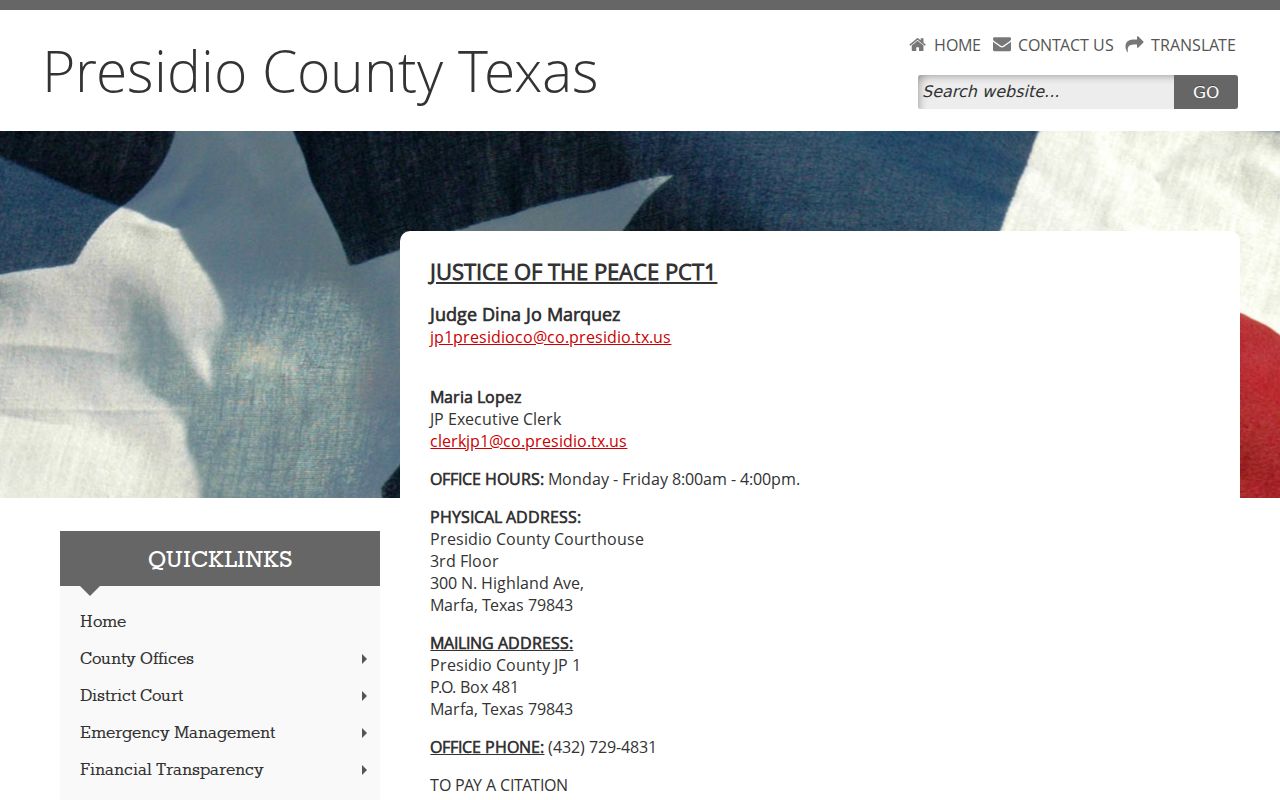
That page confirms that a justice-court record has its own office path and should not be treated as a district case.
The corresponding Precinct 2 Justice Court page covers the south-county route.
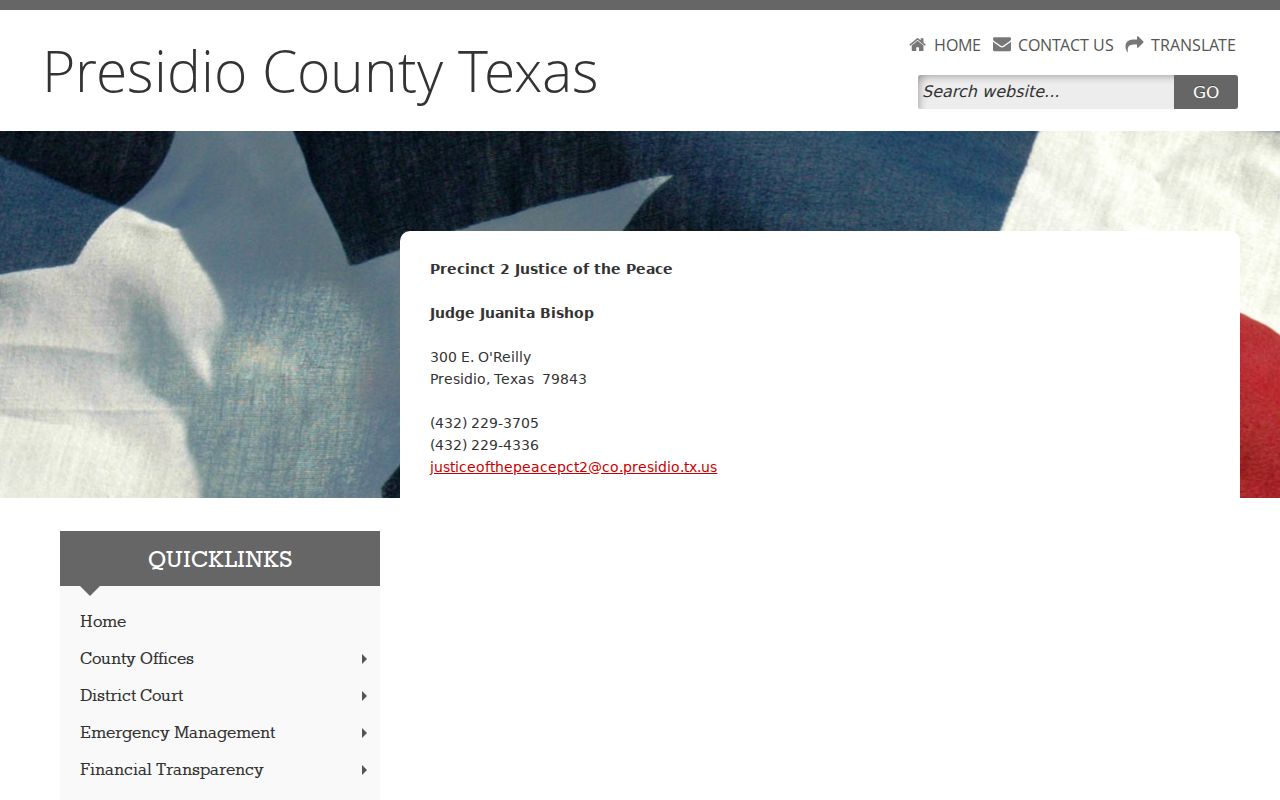
For a county this large, confirming the precinct before travel can prevent a long trip to the wrong records counter.
Presidio County Case Record Searches
No free and complete Presidio County trial-court name portal was verified. The sure route begins with the combined clerk. Give a full name, an approximate filing or arrest year, the likely court level, and a cause number when known. Ask for a docket sheet first. It is often the fastest way to identify the charging document, settings, disposition, and final order before paying for a larger file.
- Identify whether the matter is district, county, justice, municipal, or federal from the source document and offense level.
- Call the proper Presidio County clerk with the name, approximate date, and cause or citation number.
- Try re:SearchTX by party or case number, then narrow by county, court, case type, or date range.
- Read the docket in date order and distinguish settings or motions from a signed outcome.
- Request the judgment, dismissal, or other key paper from the clerk, and state whether a plain or certified copy is needed.
re:SearchTX uses account access and role-based controls. Coverage and document access depend on participating clerks, so an empty result is not proof that Presidio County has no case. Use these documented search controls as discovery fields, then confirm the record with its clerk.
| Field Label | Type | Required | Notes |
|---|---|---|---|
| Person or Party | Text | No stated universal rule | Use a full legal name and test known variants. |
| Case Number | Text | Alternative search path | An exact cause number is the best match key. |
| County | Selector | For local narrowing | Select Presidio County. |
| Court | Selector | Optional | Narrow only after identifying the court level. |
| Category or Type | Selector | Optional | Choose the criminal category when available. |
| Date Range | Date control | Optional | Use an approximate filing window. |
Note: State platform access varies, so clerk confirmation is still needed before treating a Presidio County result as complete.
Presidio County Clerk Case Access
The combined clerk's criminal counter is on the first floor of the Presidio County Courthouse, 300 North Highland Avenue, Marfa, Texas 79843. Carolina Catano is listed as clerk, and deputy Melina Carrillo uses the same office contact. Call (432) 729-3857, fax (432) 729-4313, or mail P.O. Box 789, Marfa, TX 79843. Ask whether the file is electronic, paper, or stored off-site and whether emailed scans are available. The research found no promise of a same-day walk-in search, so a call can save a trip.
Presidio County/District Clerk
Courthouse first floor
300 N. Highland Ave.
Marfa, TX 79843
(432) 729-3857
Ask for a docket sheet, document availability, current copy charges, and certification cost.
The official Presidio County/District Clerk page identifies the local records counter and contact path. It should be checked before a visit because staff details and office procedures can change.
What a Criminal Case File Contains
A Presidio County court case file links accusation to outcome. Read it by document, not by a single status label. The style and cause number identify the matter. The charging instrument states what prosecutors filed. Docket entries show events, while the signed judgment or dismissal gives the legal outcome. Sensitive identifiers, victim information, juvenile material, and protected addresses may be withheld or redacted.
| Cause Number and Court | Identifies the Presidio County tribunal and provides the best key for later requests. |
|---|---|
| Charging Document | A complaint, information, or indictment states the filed accusation and offense degree. |
| Docket Entries | Chronological settings, filings, hearings, pleas, motions, and rulings. |
| Bond and Settings | Security and appearance information, which may change as judges review the case. |
| Disposition and Judgment | The signed outcome, such as dismissal, acquittal, deferred adjudication, or conviction. |
| Sentence and Financial Fields | Confinement, supervision, fine, costs, restitution, and related terms when ordered. |
A docket may also list counsel, related cases, appeal activity, a capias, and balances. It is not the same as the statewide fingerprint-linked criminal history. For the earlier custody event, consult the Presidio County arrest search and then return to the court judgment for the outcome.
Reading Presidio County Case Dispositions
Presidio County case terms mark distinct decisions. “No-billed” means a grand jury did not indict the submitted charge. “Dismissed” means the prosecution ended that charge without a conviction, though refiling may sometimes remain possible. “Acquitted” is a not-guilty result. “Deferred adjudication” means the judge put off a guilt finding while imposing community supervision. It remains public in the DPS conviction-name product unless eligible relief changes access. “Convicted” means the court entered a judgment of guilt.
- Arraignment
- The stage when the charge is addressed and a plea may be entered.
- Motion to adjudicate
- An allegation that deferred-adjudication terms were breached, not the final ruling itself.
- Motion to revoke
- A request to change or end supervision based on an alleged violation.
- Certified disposition
- A clerk-certified judgment, dismissal, or other final paper used to prove the outcome.
The prosecutor's office can appear on a Presidio County case even though its listed work sites are outside the county. The county's District Attorney page documents those multi-county office locations.
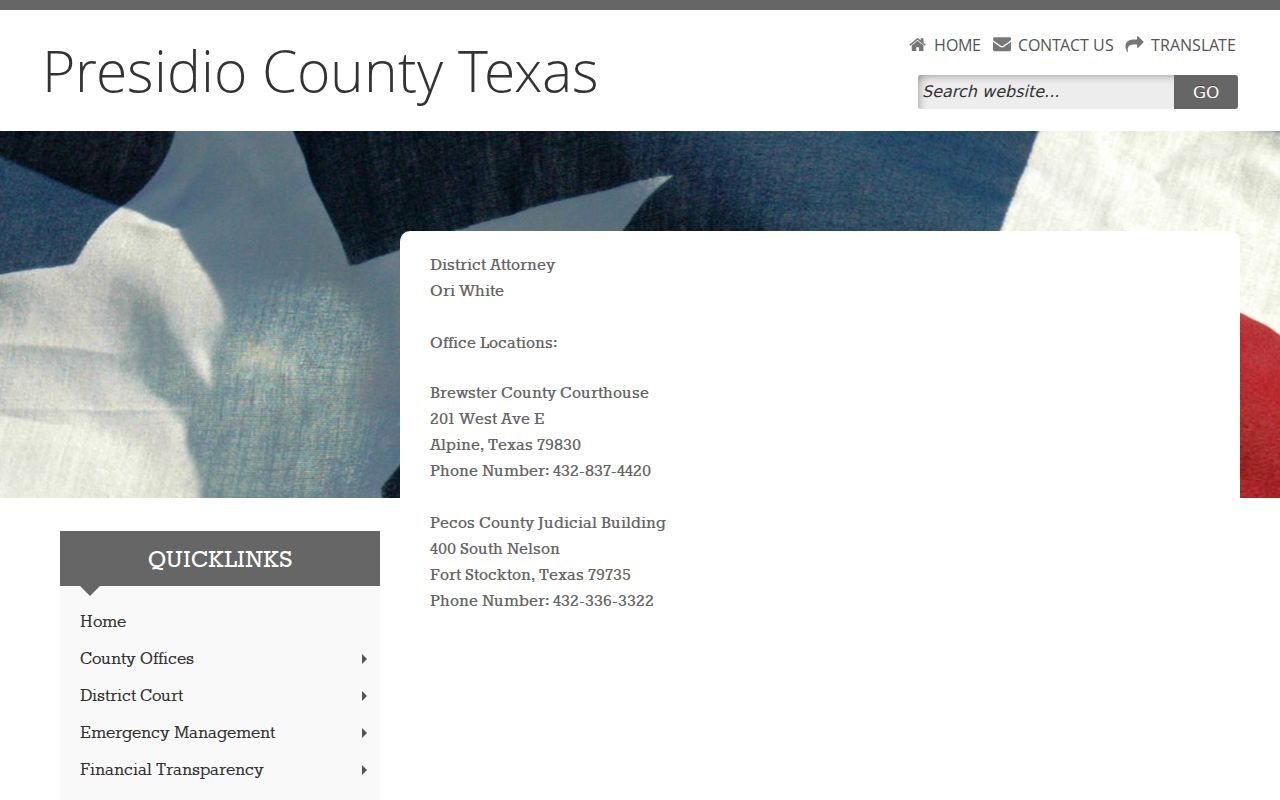
The prosecutor's location does not move a Presidio County felony file away from the clerk in Marfa.
Criminal Case Stages in Presidio County
A local court file begins after law enforcement and prosecutors create earlier records. Texas requires Article 15.17 magistration without needless delay, normally within 48 hours after arrest. The magistrate informs the person of the accusation and rights, considers probable cause where required, and addresses bond. That hearing is not a trial, and the arrest charge can still change before an information or indictment is filed.
Case flow: Charges Filed › Arraignment › Pretrial › Plea or Trial › Disposition › Sentencing
Follow the docket by date. A setting is not an outcome. An indictment is not proof of guilt. Plea papers may show an agreement, but the signed judgment controls the adjudication and sentence. If an appeal follows, obtain the appellate mandate as well because it can modify or reverse the trial result.
Archived Presidio County Court Files
An older Presidio County case may be on paper or stored away from the public counter. Ask the clerk what years are indexed by name, whether aliases are included, and whether the office needs a cause number to retrieve an archived file. Spellings matter. So do court levels. A “no record” response from one clerk should prompt a check of the issuing municipal or justice court before any broad conclusion is made.
Request the smallest useful set first: docket sheet, charging instrument, and signed disposition. Ask whether scans can be sent by email, whether the file requires retrieval time, and what current plain-copy and certified-copy charges apply. No fixed local copy quote was established in the research, so it should not be guessed. A written estimate keeps a broad request under control.
The county identifies a separate County Attorney channel for county-level prosecution context.
Prosecutor work product may remain protected even when filed pleadings are available from the court clerk.
Note: A broad records request is slower than a cause-number request for a few named Presidio County court documents.
Access Rules for Case Records
Texas court records are governed by court authority and judicial records rules as well as public-access law. The Texas Public Information Act creates a general right to inspect public information, but a generic TPIA request to DPS is not the right route for a Presidio County court file. Ask the court clerk that keeps the case. Online views may omit papers that can be inspected at the counter, while sealed and expunged matters are not open through ordinary public channels.
Government Code Chapter 552 governs public information, Government Code Chapter 411 limits criminal-history dissemination, Chapter 66 governs reporting to DPS, and Family Code Chapter 58 restricts juvenile justice records.
Victim-identifying facts, Social Security numbers, motor-vehicle data, juvenile material, and other confidential fields can be redacted. An order of nondisclosure restricts general access but does not destroy the record. Expunction under Code of Criminal Procedure Chapter 55A is a separate remedy that can remove qualifying arrest records. The clerk can provide the filed order or case paper, but eligibility advice calls for legal counsel.
Certified Presidio County Case Outcomes
A search index is useful for discovery. A certified court paper is better proof. When a Presidio County disposition must be shown to another official office, request the signed judgment, dismissal, acquittal record, or appellate mandate and ask the clerk to certify it. A docket line alone may abbreviate the result or fail to show later action. Financial entries also need context: bond is security for appearance, while fines, costs, restitution, and payment-plan charges are separate fields.
If a Presidio County outcome is missing or wrong in the Texas Department of Public Safety record, obtain the certified court document first. Then use the DPS correction process and identify the disputed arrest cycle or disposition. The clerk preserves its source record, but the reporting agency or court usually corrects and resubmits the event to DPS. Keep certified copies after an expunction or nondisclosure order because updates across agencies can take time.
Note: The signed judgment or dismissal is the safest source for a Presidio County case result, not a bare index label.